
Off-Plan vs Ready Properties in UAE: Which Is Better?
Off-plan vs ready property in Dubai: payment, mortgage limits, legal protection, risks, fees and rental timing compared, with who each option suits.
By RealtyReview.ae Team · Sep 22, 2026 · 8 min read
In this article
Off-plan vs ready property in Dubai: the short answer
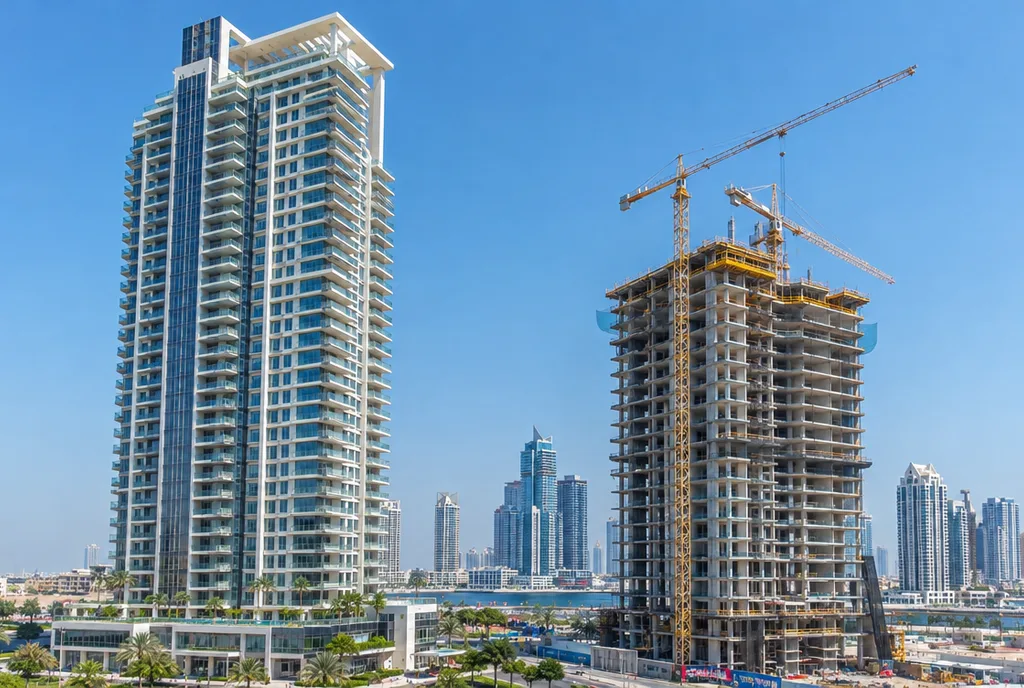
Neither is better in general. Off-plan suits buyers who want to pay in stages and can wait years for the keys; ready property suits buyers who want rent or a home now and prefer to see exactly what they are buying.
This post compares the two on the points that actually differ: how you pay, how much a bank will lend, how the law protects you, what can go wrong, when rent starts and what it costs. It uses Dubai rules unless it says otherwise. For the full off-plan process, read our buying off-plan guide.
We don't claim that either type rises in value faster. Prices can fall as well as rise for both, and no official source measures one against the other in a way you can rely on for a single unit.
How you pay: payment plan vs full price at transfer
- Off-plan: you pay the developer in instalments under the sale and purchase agreement (SPA), usually tied to construction milestones or dates. Every payment must go into the project's escrow account, never to a broker or a personal account (Executive Council Resolution No. 6 of 2010, Article 12).
- Some developers let part of the price be paid after handover. That is a commercial offer, not a legal right, so read exactly what the SPA says. Model the instalments with our payment plan calculator.
- Ready property: you pay the whole price at transfer, from your own funds or with a mortgage. A deposit of around 10% held until transfer is customary, not a legal requirement.
- Either way, the buying costs come on top of the price. See the fees section below.
Mortgage limits: 50% for off-plan, up to 80% for a ready first home
The UAE Central Bank caps how much a bank may lend against a property's value. For off-plan property, the maximum loan is 50% of the value, whoever the buyer is. The Central Bank gives the long development period and the risk the project is not completed as its reasons.
For ready property the caps are higher. An expatriate buying a first home worth up to AED 5 million can borrow up to 80% (70% above AED 5 million); a UAE national up to 85% (75%). A second home or investment property is capped at 60% for expatriates and 65% for UAE nationals. Banks can ask for more down than these minimums.
With an off-plan mortgage, the bank pays the developer only after your own share has been paid, against construction milestones confirmed by an independent party. So you need at least half the price from your own money. The details are in our UAE mortgage guide and the down-payment requirements.
Legal protection: escrow and Oqood vs what you see is what you get
Off-plan buyers in Dubai are protected by registration and escrow rather than by being able to inspect the finished unit. Ready buyers are protected by the title deed and by being able to see, measure and survey the property before they pay.
- Escrow: a developer selling off-plan must open an escrow account for each project, and buyers' payments go into it (Law No. 8 of 2007). The developer's creditors can't seize that money.
- Oqood: the off-plan sale must be registered on the DLD's interim register, and a sale that isn't registered there is void (Law No. 13 of 2008, Article 3). The developer registers it within 90 days of signing and you get a provisional e-certificate.
- Project cancellation: if RERA cancels a project, the escrow agent must refund buyers within 14 days, and the developer must cover any shortfall within 60 days (Executive Council Resolution No. 6 of 2010, Articles 25 and 26).
- Before paying anything, look the project and its escrow account up on the DLD's Real Estate Project Status service or the Dubai REST app.
- Ready property: the sale is valid only once it is recorded in the DLD register, and the title deed is conclusive proof of ownership (Law No. 7 of 2006, Articles 9 and 24). Check the deed with the DLD's Title Deed Verification service.
Risks: what can go wrong with each
Off-plan risks mostly come from the gap between signing and handover. Ready-property risks mostly come from the condition of the unit and the price you pay for it.
- Delay: completion dates can slip. What you can claim depends on the SPA's completion date, grace period and delay clause, so read them before signing.
- Changes to the unit: you may ask the court to end the contract if the developer makes material changes to the agreed specifications or hands over a unit unfit for use because of material defects (Executive Council Resolution No. 6 of 2010, Article 20). If the net area is more than 5% smaller than agreed, the developer must compensate you (Article 13).
- Your own default: if you miss instalments, the DLD gives you 30 days' notice. After that, the developer may terminate and keep up to 25% of the unit's value if the project is under 60% complete, or up to 40% if it is 60% complete or more; above 80% it has other options, including auction (Law No. 13 of 2008, Article 11, as amended by Law No. 19 of 2020). These are percentages of the contract value, not of what you've paid, so early in a plan you could lose most or all of your payments.
- Price change before handover: the market can move in either direction during construction. If prices fall, the bank's valuation at handover may be lower than your price, and any mortgage is based on that valuation.
- Ready property: hidden defects, service charge arrears or an existing tenant. Get an independent inspection, ask the seller about arrears, and check the tenancy. A Dubai landlord who wants a tenant out for a sale or personal use must give 12 months' notice by notary public or registered mail.
When the rent starts
A ready property can earn rent from the day you get the keys, and sometimes from day one if you buy with a tenant in place. An off-plan unit earns nothing until it is handed over, snagged and let, which can be years after your first payment.
That gap matters for returns. Money paid during construction earns no rent, and if you pay part of the price after handover, those instalments come out of the rent. Once you let the unit, the tenancy must be registered on Ejari. Work out the income side with our rental yield calculator.
Fees: what each costs to buy
- DLD fee: 4% of the price for both types. The DLD lists it as 2% from the buyer and 2% from the seller; who actually pays is agreed in the SPA or sale contract. For off-plan, it is charged when the sale is registered on Oqood.
- Ready property: registration trustee fee of AED 4,000 + VAT for properties of AED 500,000 or more (AED 2,000 + VAT below), and AED 250 for the title deed.
- Mortgage registration: 0.25% of the loan plus AED 250, for both types.
- Agency commission on a resale is agreed with the broker; about 2% plus 5% VAT is customary, not a legal rate. Buyers commonly pay no commission on a direct developer sale, but confirm it in writing.
- Developers may not charge fees on an off-plan sale or resale beyond administrative costs the DLD has approved (Law No. 13 of 2008, Article 7). Ask for the fee schedule in writing.
- Service charges start at handover for off-plan and at transfer for ready property. Check the building's approved rate in the DLD Service Charge Index. The full list is in our property buying costs guide.
Snagging and defects liability
Off-plan buyers take a brand-new unit and get statutory defect cover from the developer. Under Law No. 6 of 2019, Article 40, the developer must repair or replace defective installations for one year from handover and is liable for structural defects for ten years from the completion certificate. In addition, 5% of the project escrow account is kept back until one year after the units are registered (Law No. 8 of 2007, Article 14).
Snagging (inspecting the unit and listing defects before you accept it) is market practice, not a legal term. Get the developer's written acknowledgement of every item. Our handover guide walks through it.
A ready resale unit may be outside those periods, depending on when the building was completed. Pay for an independent inspection and price in any repairs before you sign the sale contract.
Which is better for you?
- Off-plan may suit you if you want to spread payments over time, can do without rent until handover, have at least half the price in your own funds if you'll borrow, and can keep paying even if your circumstances change.
- Ready property may suit you if you need a home or rental income now, want a mortgage of more than 50%, or want to inspect the actual unit, building and service charges before you pay.
- For either, check the developer's delivery record and buyer reviews on our best developers list, and read the SPA or sale contract with a lawyer if the sums are large.
Sources
- UAE Central Bank, Regulations Regarding Mortgage Loans (Circular No. 31/2013, as amended)
- UAE Central Bank, Resolution No. 31/2/2020 amending Circular No. 31/2013
- Law No. 8 of 2007 Concerning Escrow Accounts for Real Estate Development
- Law No. 13 of 2008 Regulating the Interim Real Property Register
- Law No. 19 of 2020 Amending Law No. 13 of 2008
- Law No. 7 of 2006 Concerning Real Property Registration
- Law No. 6 of 2019 Concerning Ownership of Jointly Owned Real Property
- Executive Council Resolution No. 6 of 2010 and Bylaw No. 85 of 2006, in Dubai Land Department, Dubai Real Estate Legislation
- Law No. 33 of 2008 amending Law No. 26 of 2007 (tenancy)
- Dubai Land Department, Request to Register the Initial Sale (Oqood)
- Dubai Land Department, Property Sale Registration (fees)
- Dubai Land Department, Mortgage Registration
- Dubai Land Department, Real Estate Project Status
- Dubai Land Department, Frequently Asked Questions (escrow and 5% retention)
- Dubai Land Department, Service Charge Index
- Dubai Land Department, Verify Title Deed
Key Takeaway
Off-plan spreads the payments and is protected by escrow, but you wait for the keys and carry delivery and default risk. Ready property costs more cash up front and earns rent sooner, and you can inspect exactly what you are buying.
¿Te ha resultado útil este artículo?